Sunday, October 17, 2010

staff notes


starlings are beginning to gather into large flocks, and when they perch on a stave of telegraph wire look like Elizabethan lute music notation.

Sunday, October 10, 2010

last of the summer wine 3


and a late red admiral basking in the unusually warm October sun, showing the amazing complexity and subtle colouring of its underwings.

last of the summer wine 2


this is a stinkhorn, usually smelled rather than seen, but this was a very fresh and especially pungent specimen. It spreads its spores by attracting flies which land on the slimy sticky tip and carry the spores away.

last of the summer wine


this jet black mushroom is a chanterelle known as Horn of Plenty or Black Trumpet, and in France as la viande des pauvres (poor man's meat) where it is used in stews. It is an occasional species found on oak and beech leaf litter (note acorn in top photo). This is the first time it has appeared for four years at this particular spot.

Wednesday, October 06, 2010

at the Honey fair Callington 3


Kit Hill in the background adding some perspective to the man on stilts


street entertainers for MacMillan nurses
.

the handiwork of local primary schoolchildren.

at the Honey fair Callington 2


John Trevithick (under trilby), Lawrence Reed (VIP) and town criers of Bodmin and Launceston.


the loudest guy on the street (from Saltash of course).

and the town criers of Callington, Saltash, Newton Abbot, Crewkerne, Torbay, Bodmin, Ilfracombe and Barnstaple

at the Honey fair Callington 1


Today was honey fair day in Callington. This may go back many years (see link) but has been revived more recently by John Trevithick whose family have lived in the town for 200 years. Apart from the usual stalls full of knickknacks, cheap toys and trivia, there was a Town criers competition (won by the bard of Launceston), a honey tasting competition, and a visit from Lawrence Reed of radio Cornwall. All very exciting for us rural types.

Monday, October 04, 2010

last night


it was a very fiery, but short lived sunset last night.

web jewel


a spider's web glistening in the early morning dew, looking like an elaborate necklace when seen in close up.

Sunday, October 03, 2010

autumnal images


sloes, sweet chestnuts, and I am not sure what. possibly wrinked club, but all are redolent of autumn

Sunday, September 26, 2010

the view from Pleasure rock

the Tamar valley just below Gunnislake, looking towards Drakewalls and St Ann's Chapel, on the old railway line from Devon Great Consul mine to Morwellham Quay (see Tamar Valley AONB link for more information about these walks). I wonder how the rock got its name. Below is a picture of Gunnislake from the south side of the valley.

Saturday, September 25, 2010

on the road to autumn

moonbows


a full moon, and the eerie sight of a moonbow from light refracted from ice crystals in the clouds. Why are moon shadows so much sharper than normal shadows?

Monday, September 20, 2010

not for the faint hearted


no martins or swallows now, but plenty of garden spiders pretending to be much bigger fiercer animals from above.

Friday, September 17, 2010

relief

the martins have left the nest. I hope they make it to Africa.

Tuesday, September 14, 2010


No, not another boring skyscape. The little black dots that look like grains of dirt on the lens are dozens of martins gathering for the return south. But they can't leave yet because there are STILL fledglings in the nest.

Sunday, September 12, 2010

or fearful symmetry


just making sure we leave the area, and quickly

on the forest floor


this pretty little flower is trailing St John's wort, one of 13 different species of this perennial (hypericum) which range in size from the very small as here to the Rose of Sharon. On close up you can see the little black glands along the edge of the petal which contain various oily compounds including the compounds responsible for its antidepressant properties.

Wednesday, September 08, 2010

chaffinch return


There has been a complete absence of chaffinches in the garden this summer but suddenly they have reappeared. Where have they been? There has been a lot of concern recently (see link) about the plight of chaffinches, who are vulnerable to a protozoan infection caused by trichomonas, and we thought that maybe the local population had been infected, but it appears not, at least not completely. I suspect they find easy pickings away from garden feeders.

Tuesday, September 07, 2010

very very late


I think there are four very late martins in this nest under the apex of one of the eaves of our house, two of whom can be seen just poking their heads over the edge of the nest.

Sunday, September 05, 2010

goldenrod


It is not Autumn yet but the countryside is beginning to show signs of the end of summer. Puffballs are appearing, and goldenrod is flowering in fields of scabious. And our martins have still not fledged ...they are cutting it very fine if they are going to build up enough fat reserves to fly to Africa.

Saturday, September 04, 2010

drawn in the valley


a couple of images from the studio of a local artist, Mel Guy (see link for more), which magically capture in pewter the rhythm and laminar flow of the Tamar, plus one photographic image of the water which illustrates the visual synergy of metal and water to be found in her work.


Her studio was open as part of an event arranged by Drawn to the Valley, a group of local artists, and part of the ever flourishing artistic scene in the SouthWest. Martin Clark is another member of this group, who lives in Stoke Climsland and paints many local scenes. Aren't we lucky.

Monday, August 30, 2010

the admiral has landed

after a long journey through space the red admiral has landed at tranquility base (notice strong curvature of horizon on this small rocky planet). And this was only after fighting off several wasps to feed on a fallen apple. This was clearly one of those "don't mess with me" types of butterfly.


and much to our surprise the martins are raising another brood. They won't have much time to fatten up before they return to Africa.

autumn is coming


the berries of guelder rose are a brilliant and eye catching red, which is why only a few are left on the bush

Sunday, August 29, 2010

on a bed of angelica


a 14 spot ladybird (very small, less than 5mm long and therefore not one of the dreaded variations of the harlequin ladybird) foraging in the seed head of angelica, the flowers of which are very popular with a range of flying bugs (see below)


Friday, August 27, 2010

what is it up to?

does anyone know why this slug is abseiling off the buddleia?

Sunday, August 22, 2010

fruits of the meadow


blackberries (plus flies) rose hips, bird's foot trefoil, knapweed all in a great tangle of signs and semiotics (see link)

very beesy dandelion


in a meadow full of flowers it is puzzling to see so many bees on a solitary dandelion. There must be something very special about dandelion nectar.

Harlequin invaders


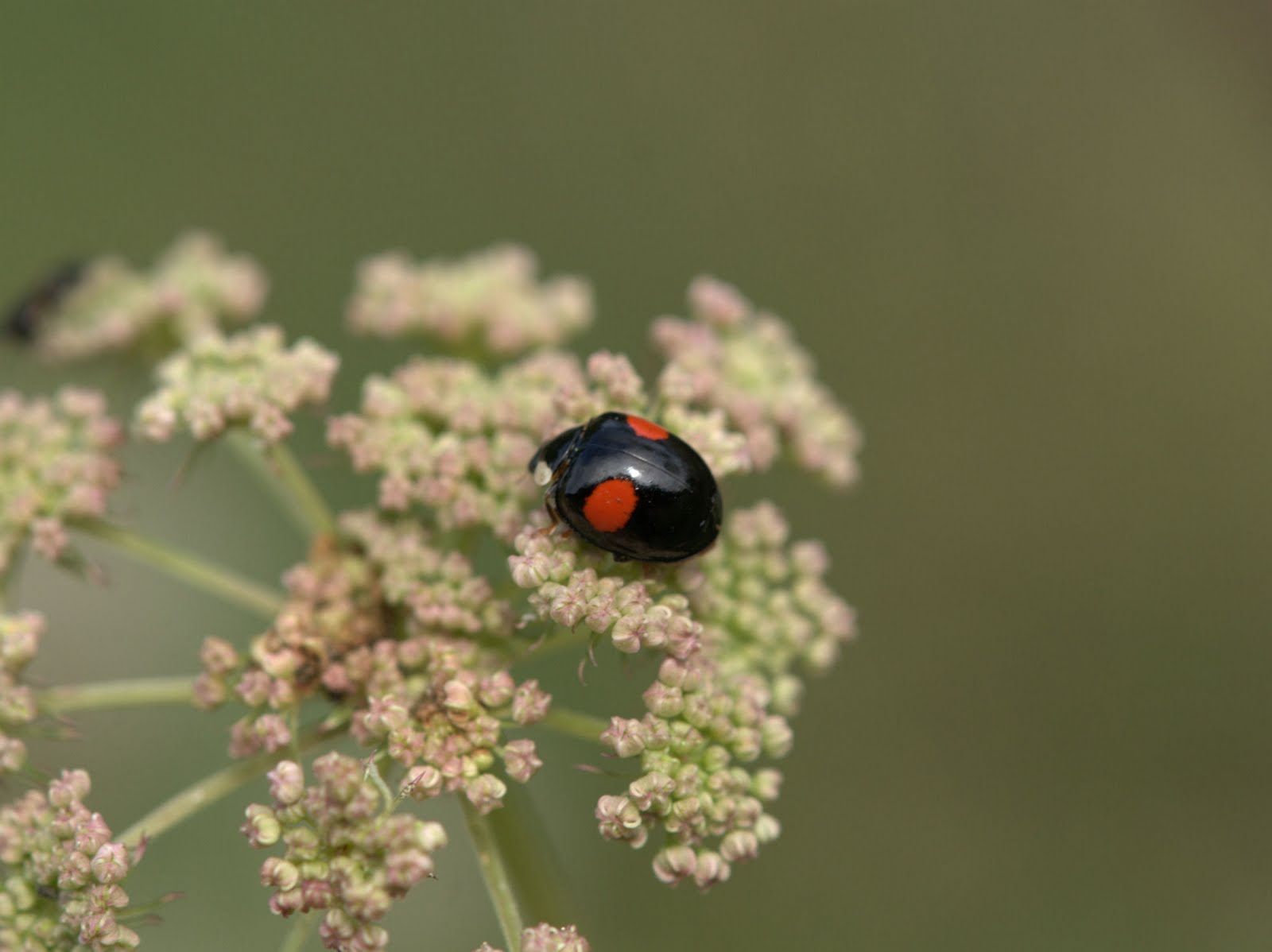
all of these harlequin ladybirds were on one large piece of hogweed in the meadow today. They are displacing the native two spot ladybird and were not even mentioned in my 1985 edition of the Illustrated book of Insects

Miss best tortoiseshell 2010


the prettiest tortoisehell on the block