Sunday, November 17, 2013

autumn 13


images from our walk in Greenscombe woods today

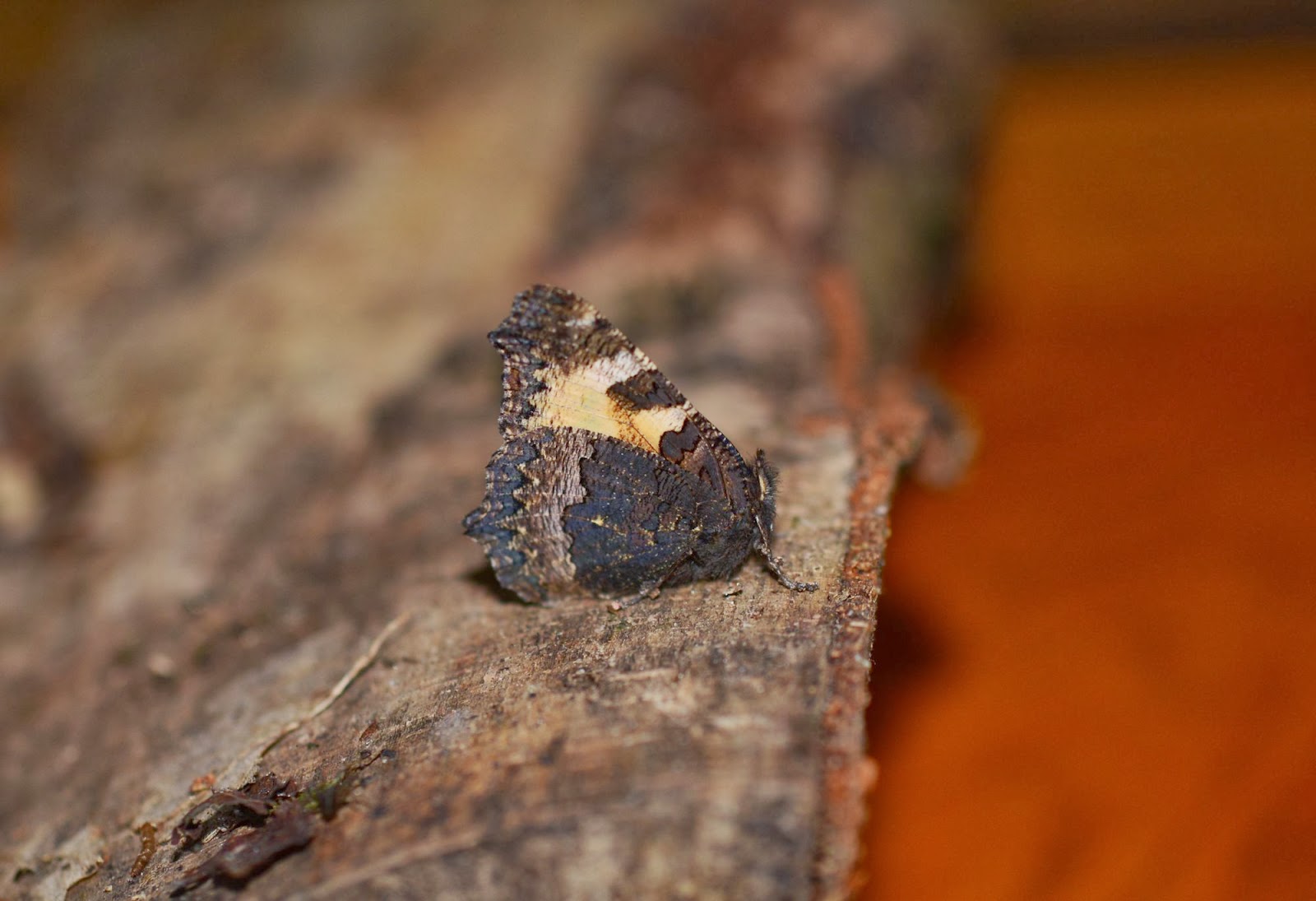
deep sleep


A tortoiseshell caught hibernating on a log from the wood shed. It is extremely well camouflaged in this situation by the seemingly drab pattern of the underside of its wings.

Tuesday, November 12, 2013

Sunday, November 03, 2013

windy days


We have experienced a succession of wet and windy days recently. It is hard to capture the wind in a photograph but the pampas grass gives some idea of the strength of the wind. And the scene below is of the Tamar valley in its autumnal clothes. There hasn't been much to photograph recently!


Saturday, October 26, 2013

on the forest floor


Back to more local matters. It looks like it is going to be a good year for mushrooms, and they are beginning to appear in abundance wherever the leaf mould has started to form.


There are so many species of similar looking fungi it is very hard for an amateur to tell them apart. The middle  photo is of a species of russula, probably the aptly named sickener, or russula emetica, for that is what it does. The bottom photo is of slippery jack, a very slimy fungus (reputed to be edible as long as the slimy cap is removed!)


Tuesday, October 22, 2013

King Canite


we have spent a very pleasant week in Kalkan, Turkey, hence the lack of pictures of heavy rain. All the dogs run wild but seem well cared for, one way and another. They run round looking for people to whom they can attach themselves (rather like sophisticated street chuggers) so we were obvious soft touches. It is interesting that dogs seem to need us to go for a walk. This one seemed Canute like in his willingness to demonstrate that the sea was not to be deterred.

Thursday, October 10, 2013

very last of the summer wine


It was a brilliant if cool sunny day today, and there were several tortoiseshell and red admiral butterflies fluttering about, feeding before their long winter hibernation. There was also a crowd of small coppers (top picture), the last of several generations this year. Later generations are supposed to be larger but these were very small if bright butterflies. And there are still a lot of bumblebees around making honey while the sun shines.

Sunday, October 06, 2013

woolly bears?


a very large caterpillar found crossing the road up to Kit Hill. It looks a bit like the caterpillar of the tiger moth known colloquially as woolly bears, but it is very large for a tiger moth caterpillar and a slightly different colour. I haven't been able to identify it. Many caterpillars are leaving their food plants now to look for somewhere to hibernate.

Wednesday, October 02, 2013

welcome visitor

A nuthatch, in its characteristic upside down feeding position, making a rare visit to the peanuts. It is a feisty little bird and tends to drive off other birds when it is feeding.

Monday, September 30, 2013

little and large


the smallest of the small (? mycena or marasmius sps) growing in a forest of moss, and a large parasol mushroom emerging in a hedgerow.

now what?


Spot following in his mother's footsteps (link)

Saturday, September 28, 2013

a tissue of life

this little white drab daisy like flower is sneezewort. It is odd how something quite common like this can pass one by. Apparently the smell of it can make a man (and presumably a woman) sneeze. It was widely used to treat toothache, and blocked noses. Its leaves have a biting  hot taste and have been used in salads. Found in Ged's fields at Bridestowe yesterday during a very pleasant walk, and lunch at the excellent White Hart Inn (see link) who have an enormous Great Dane puppy which put the fear of dogs into Spot.

Sunday, September 22, 2013

we'll ring you

Not all of our red telephone boxes have been removed, and some have been pressed into new life. Not sure that there will be a riot in Latchley any time soon.

Tamar views

Reflections in the river, at Latchley, below Old Solomon's farm.

Saturday, September 21, 2013

a different universe


The location of this image is given away by the fine silk strands holding the bubbles.

Monday, September 16, 2013


a strange looking bumblebee, which, even with the help of the Natural History Museum site (see link), I can't identify. It is probably a variant of something common. Only last night we were talking about grey wagtails, and lo and behold there was a small flock of them patrolling on the Inny this morning (the barely visible smudge of yellow on the rocks)
.


Friday, September 13, 2013

and so life goes on

We weren't the only ones to go blackberrying today. Strangely quiet without Max to fret about.

Thursday, September 12, 2013

the spirit of Max

After a long and slow decline, and a rapid turn for the worse this last few days, Max was put quietly to sleep today.


He was 15 and a bit. He loved being chased by other dogs but often couldn't find anyone to chase him so took up endlessly exploring the garden around the house. He hated water, men with flat hats, and any mention of any part of his anatomy. He was epileptic and needed treatment throughout his life. He wanted to learn but was incapable of instruction. So, having lived all his life here he has been buried next to a new walnut tree along side his best canine mates Cassie and Sophie.


Farewell, old friend.


flower by Harriet Edwards

Friday, September 06, 2013

nectar robbing


Evidence of bumblebee theft, the lower part of the petal tube of garden phlox has been stripped  away allowing easy access to the nectar.

Wednesday, September 04, 2013

garden flocks


While I watched a sparrowhawk being mobbed by martins today as it hovered over the garden looking for sparrows, and a humming bird moth on the garden phlox something else caught my eye. Large bumblebees kept on disappearing into the heads of garden phlox (see top photo). On closer inspection it transpired that the bees were feeding from the base of the flower, between sepal and petal tube (see lower photo) rather than from the flower heads themselves. Is this common? I haven't found a reference to this behaviour on some brief internet searches. It would seem to negate the normal method of pollination.

PS I have found a reference now to this behaviour, it is called nectar robbing (see link). The reason it did not come up at first is that this site does not mention phlox. Looking at the flower one can see it has a very long petal tube, and I guess these bumblebees cannot reach the nectar at the bottom, so have to drill a hole in the petal tube... fascinating.

Monday, September 02, 2013

Collies can swim


Photographic proof that some collies can swim! Meg will do anything to get hold of a stick before Harriet and Spot. Most collies we know won't even get their toes wet.

Sunday, September 01, 2013

15 in one day 2


It was all getting a bit crowded. Bramble and knapweed have almost stopped flowering, and the meadows are full of devil's bit scabeous. The patches of scabeous were covered with a variety of pollinators getting their last top ups of the summer, drunk with nectar they were very docile allowing this sumptuous aerial view of a peacock.


15 in one day


We saw 15 species of butterfly today on our walk along the Inny, including several more clouded yellows. They always close their wings at rest, but the top picture shows quite clearly the black edging on the upper surface of the wings of these distinctive butterflies when seen on the wing.

Sunday, August 25, 2013

a magic day

We went for a walk along the Lynher below Golberdon this morning with Charlie, a young member of Spot's human family. We saw some common blue butterflies, some dragonflies and a hornet, all very interesting, but then we saw 4 kingfishers all in a little group flying towards us and then around the banks before eventually this one perched on a branch above the river.... magic!! This must be the second brood of the year, and the young must have just fledged as the adults usually drive the young away after a couple of days.

Oh, and the joys of mucking about in the river!


Wednesday, August 21, 2013

Monday, August 19, 2013

no blood on the tracks


this is the bloody nosed beetle, so named because of its habit of exuding foul smelling red coloured fluid from its mouth when annoyed (see link). This specimen was not sufficiently annoyed by us to do anything more than wave an antenna somewhat feebly in our direction.

Sunday, August 18, 2013

clouded arrival

Yesterday was a dreary wet day so I read the morning newspaper more thoroughly than usual. In it, Simon Barnes, sports writer and naturalist, wrote an article (link) in which he described the pleasure  of watching birds and butterflies with his young son, Eddie, who happens to have Downs.They are holidaying somewhere on the coast further west in Cornwall. He reported seeing several clouded yellows, an occasional migrant from Southern Europe, and not for the first time I felt quite envious of him. Lo and behold we saw several today on our walk, the first I have ever seen locally. They are very skittish and almost always fold up their wings at rest, which is a pity because the black edged pattern on the upper surface of the wings is quite striking.


There were also a lot of common (but not so common) blues around.